First Building Sets Benchmark for Sustainable Offices
The First Building, housing Stage 1 of the Advanced Manufacturing Readiness Facility (AMRF), represents a new era of collaborative, future-focused workspaces in Western Sydney.
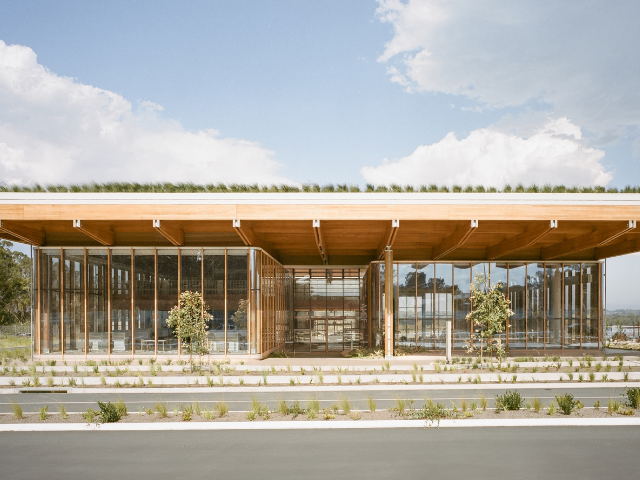
GALLERY
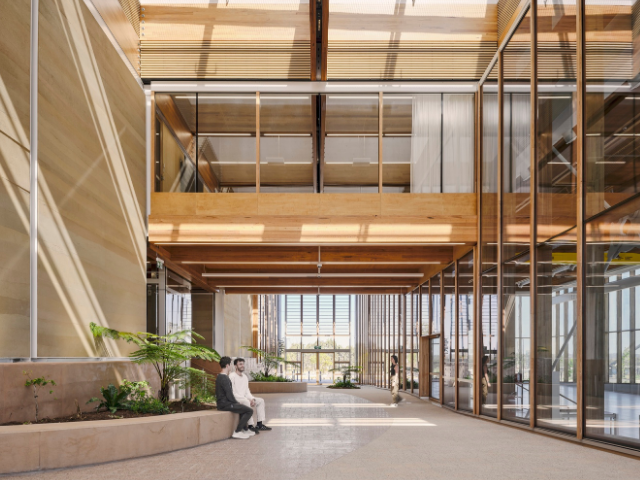
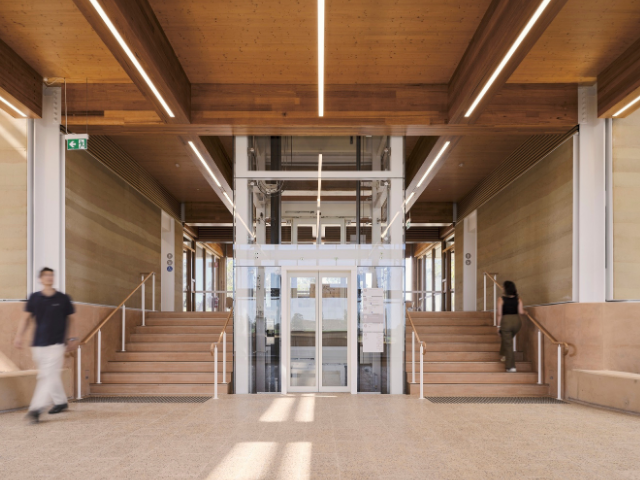
Located in the emerging city of Bradfield within the Aerotropolis region, the building brings together government, industry and research to incubate advanced manufacturing projects while honouring the cultural and ecological heritage of the site.
Designed as the inaugural building for Bradfield, the structure functions both as a workplace and a public pavilion, complete with a visitor centre and viewing areas to showcase real-time construction progress. Its design, informed by First Nations cultural research and design agency Djinjama, celebrates the meandering and ephemeral water systems of the Cumberland Plain. Through a richly planted landscape of native species and integrated water features, the site’s permeability has been reinstated, enabling natural runoff collection and filtration while supporting biodiversity.
The building’s form and layout respond to the existing paddocks and tree stands, maintaining a human scale while signalling the future density of the surrounding city. Its architectural expression draws on water and fluidity, combining warm, natural materials with open, welcoming spaces. The site, known in the local Dharug language as Wianamatta or Mother Place, is recognised for its significance to First Nations women, and this cultural importance is embedded in the building’s inclusive, site-sensitive design.
Sustainability is central to the First Building’s approach. Rainwater is captured for greywater reuse and landscape irrigation, and nearby water bodies, including the longest freshwater stream in Greater Sydney, are being regenerated to slow runoff and enhance natural filtration. The permeable ground plane, planted with locally underused Cumberland Plain species, reconnects the site with its ecological identity and sets a precedent for future development across the Aerotropolis.
The project also reflects principles of circular economy and adaptability. Prefabricated modular timber components form the building’s kit-of-parts structure, which can be disassembled, expanded or relocated as the city grows. According to Djinjama’s Danièle Hromek, designing the First Building presented a “massive opportunity across time and space,” allowing the building to remain relevant even after its initial use has evolved.
By merging advanced manufacturing infrastructure with cultural storytelling, ecological restoration and flexible construction methods, the First Building establishes a benchmark for sustainable, connected, and human-centred design in Western Sydney. It demonstrates how urban development can celebrate heritage while preparing for a rapidly evolving city.
Images by Vinchy Wu via ArchDaily


MA Financial has acquired a 50 per cent stake in The Glen shopping centre in Melbourne’s south-east from ...
In Wilcannia, a new cultural centre is doing more than providing space for art, language and community gatherings. ...
A former shopping centre and warehouse site on the edge of Surry Hills and Redfern has been transformed ...
South-East Queensland developer Harridan has lodged plans for a 16-storey mixed-use tower in Woolloongabba, proposing to transform an ...
For more than 25 years, Rockstar Sealing has been at the forefront of natural stone care, delivering complete, ...