Penadés tiles Tokyo Camper store into “archipelago” of modular display forms
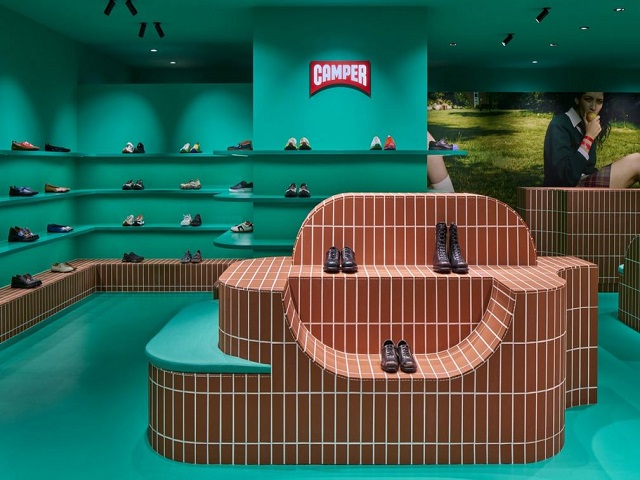
Madrid-based design studio Penadés has reimagined Camper’s Shin Maru store in Chiyoda, Tokyo, with a sculptural interior defined by terracotta-tiled forms described as “an archipelago” of retail objects.
GALLERY
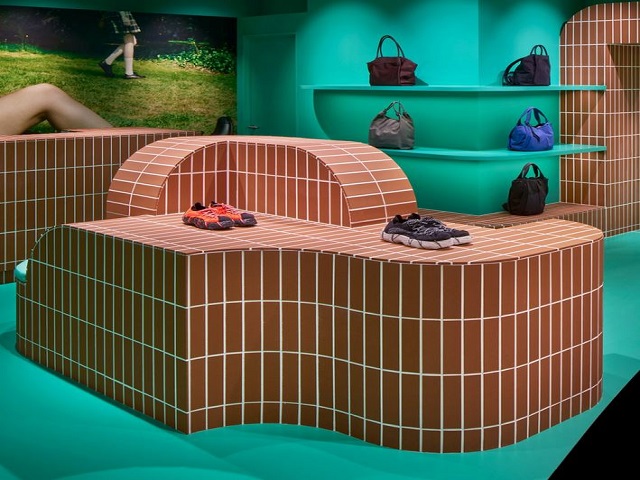
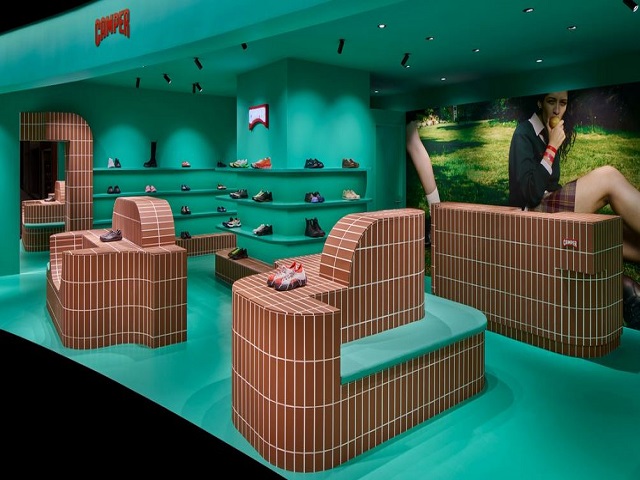
The overhaul presents Camper footwear across a series of curvaceous clay-tiled blocks that function as display stands, seating and a cash desk, all set within an aquamarine-toned interior.
The same tile language extends across doorways and perimeter shelving, creating a continuous architectural field rather than discrete retail fixtures.
Penadés said the design continues a system-first approach developed for Camper stores in Paris, Hong Kong and Bangkok, where each interior is generated from a consistent set of geometric rules rather than bespoke spatial planning. Straight lines and two-dimensional curves underpin the modular furniture pieces, allowing tiled surfaces to be efficiently applied across different configurations and store footprints.
“The objective was to design a retail system that could be applied globally, but always using local materials,” said Jorge Penadés. “Based on the Mediterranean DNA of the brand, we bet on clay tiles: a humble, economic and sustainable material that can be found anywhere in the world in order to minimise the impact of our activity.”
The strategy is positioned as a response to the environmental burden of global retail fitouts, which often rely on shipping prefabricated materials across long distances. Instead, Penadés’ system prioritises adaptable components and locally sourced finishes, reducing material transport while maintaining a consistent brand identity.
Each Camper store iteration introduces subtle material shifts. Previous versions have included glossy red tile treatments or swapped ceramic entirely for locally sourced timber veneers, demonstrating the flexibility of the underlying system while retaining a unified spatial logic.
In Shin Maru, the aquamarine colour palette references the Mediterranean Sea and Camper’s Mallorcan origins, reinforcing a recurring design language across international locations. “We try to use shades of blue and green in most of our Camper stores, to reference the island,” Penadés said.
The studio also described the project as a cultural dialogue between design traditions. “This store is a collaboration between Mediterranean culture and Japanese precision,” Penadés added.
By combining repeatable geometry with locally grounded materials, the Shin Maru store positions retail design as an evolving architectural system rather than a fixed interior, offering a model for lower-impact global retail environments.
Images by Koji Fujii via Dezeen


The growing focus on natural materials and texture is changing the way we think about surfaces. Walls, floors ...
There is something inherently beautiful about a surface that doesn't look perfectly manufactured. Subtle shifts in tone, handcrafted ...
Inside the KnoxOne showroom, two dedicated wardrobe spaces have been designed to present BASISTEM not as a collection ...
Swiss architect Kristijan Markoc has created a deliberately modest two-bedroom timber home designed to be adapted to different ...