Warsaw Net-Zero Office Proposal Champions Adaptive Reuse
A proposal for a landmark net-zero office development in Warsaw is demonstrating how adaptive reuse can play a central role in the future of sustainable urban design.
GALLERY
Known as ReVistula, the project transforms an existing office building on the city’s Vistula riverfront into a climate-conscious workplace that prioritises circularity, ecological performance and long-term environmental value.
Designed by MJZ in collaboration with Łoskiewicz Studio for Syrena Real Estate, the proposal challenges the conventional approach of demolition and redevelopment. Instead, it reimagines the existing structure as a premium workplace tailored to the growing demand from international tenants seeking spaces that align with Environmental, Social and Governance (ESG) standards.
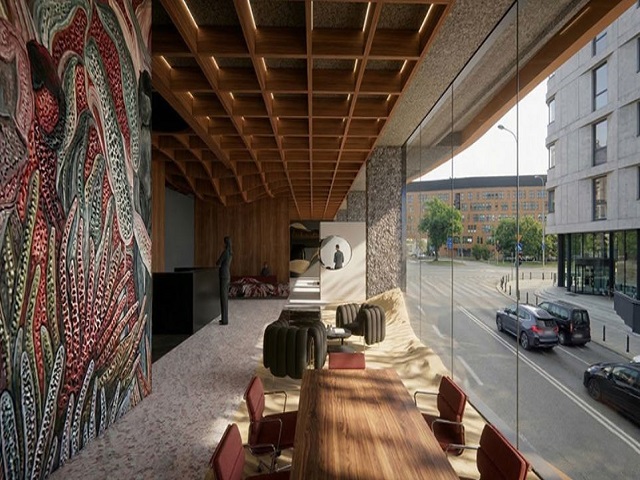
The design process began with a detailed assessment of the building’s existing structure, solar exposure and opportunities for material recovery. Elements from the original façade are repurposed within the new interiors, while exposed concrete slabs celebrate the building’s existing fabric and significantly reduce the environmental impacts associated with demolition and reconstruction.
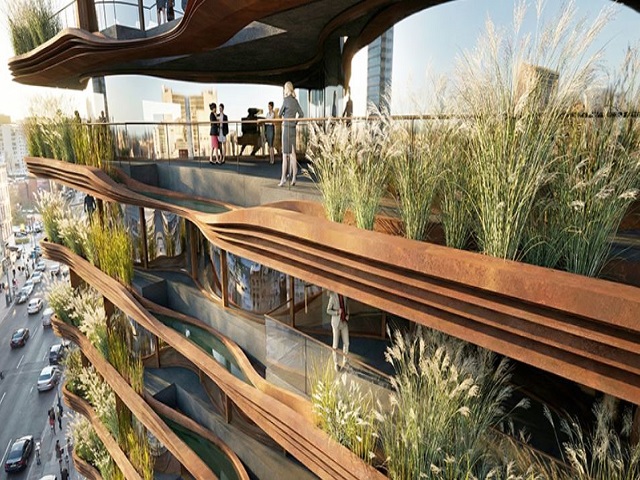
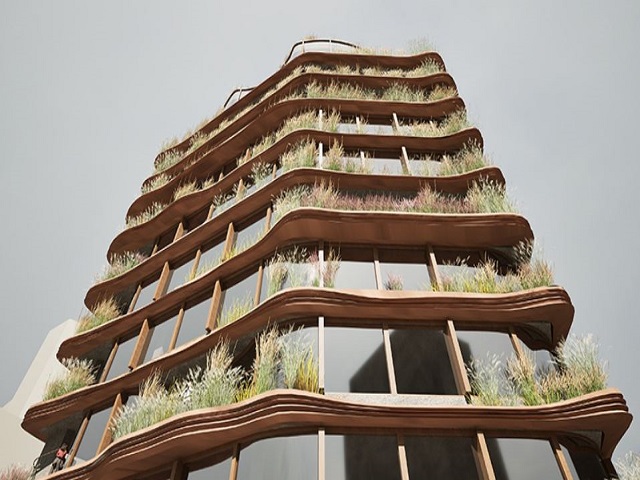
A new timber-framed glass façade is recessed within the building envelope, creating natural shading and allowing the existing floor slabs to extend outward as terraces. These outdoor spaces form part of a broader ecological strategy inspired by the Vistula River, transforming the office into a responsive environment that integrates architecture, landscape and climate performance.
Water management plays a key role in the project’s sustainability ambitions. Horizontal channels circulate water through planted zones where tall grasses naturally filter and cool it. The hydro-botanical system supports greywater reuse while contributing to occupant comfort and enhancing the building’s environmental performance. Vegetation throughout the terraces also provides passive shading, helping reduce solar heat gain during warmer months.
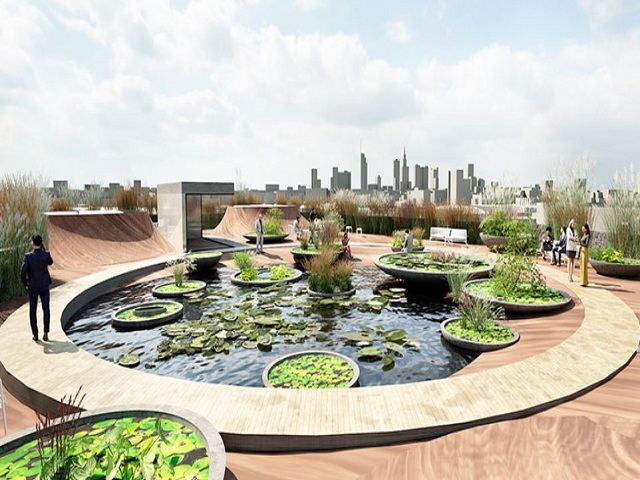
Above, the rooftop is envisioned as a hydro-botanical landscape combining water reservoirs, greenery and communal amenities. Mechanical equipment has been relocated below ground to maximise usable outdoor space, while an additional floor constructed using a cross-laminated timber waffle slab structure introduces flexible areas for work, events and recreation.
At street level, coworking facilities and a restaurant strengthen the building’s connection to the surrounding city. Interior finishes draw inspiration from the sandy riverbanks of the Vistula, while graphic elements reference local plant life and Warsaw’s iconic mermaid symbol.
Supported by detailed sustainability analysis and cost modelling, ReVistula presents a compelling blueprint for transforming existing buildings into environmentally responsible workplaces that contribute positively to both their urban context and the communities they serve.
Images courtesy of MJZ via Designboom


Building in the Galápagos Islands means working within one of the world’s most environmentally sensitive landscapes. For architect ...
A new town centre and a land-lease village of up to 364 homes are proposed for Yalyalup, as ...
Melbourne’s historic Jam Factory is being reimagined as a $4 billion mixed-use precinct, with GURNER aiming to turn ...