Window Installation & Flashing by Paarhammer
When installing windows, exterior doors and facades, thermal insulation, moisture protection (condensation, driving rain), and sound insulation have to be taken into account. There may also be specific requirements for the airtightness of the building envelope for energy efficiency. Different construction methods of the building, e.g. solid construction, lightweight construction, timber framing, etc. require different approaches to window and door installation.
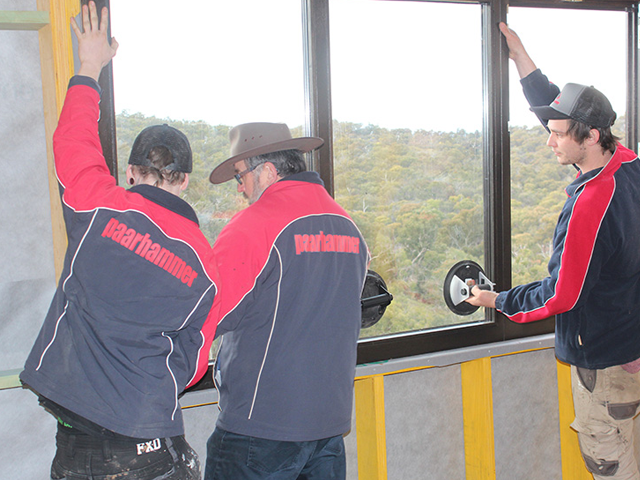
GALLERY
One of the most important parts of window installation is flashing to protect against water ingress which can result in water damage, rot and mould. While windows are tested for water ingress and wind load, very little can be done by the window supplier to prepare windows to be installed in any possible building envelope. Flashing requirements need to consider variations in climate, geographic conditions, exposure of the window to the elements, the type of construction and other design requirements.
Performance Requirements
The Building Code of Australia (BCA) under the National Construction Code (NCC) provides performance requirements which are covered under AS2047 and AS1288. The Australian Glass and Windows Association (AGWA) provides guides to ‘Residential Window Installation’ and to ‘Window and Door Fixing’. The below information is from the AGWA Window Installation Guide:
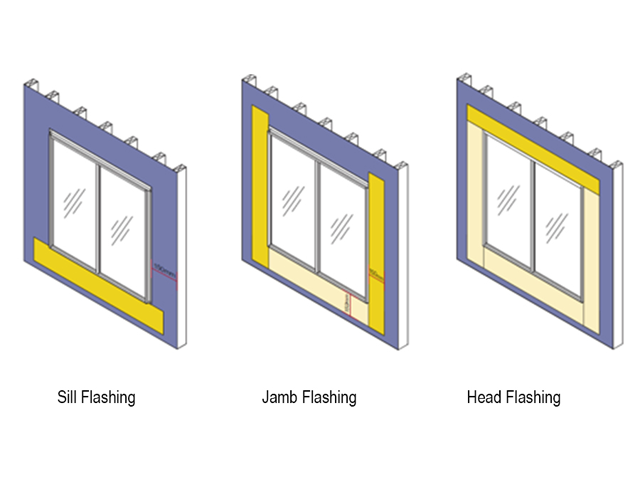
There are three types of flashing: Sill, Jamb and Head. Flashing must be installed from bottom to top, in the following order, so that each layer overlaps the one below:
- Sill flashing
- Jamb Flashing
- Head Flashing
The sarking above the window overlaps the head flashing. Overlap is vital to ensure that, at each transition, water is directed onto the element below. Drainage must be provided below the window or door, so that any water captured has the ability to escape to the outside of the wall.
Special consideration needs to be given to window and door systems designed specifically for acoustics and energy efficiency.
Passive House
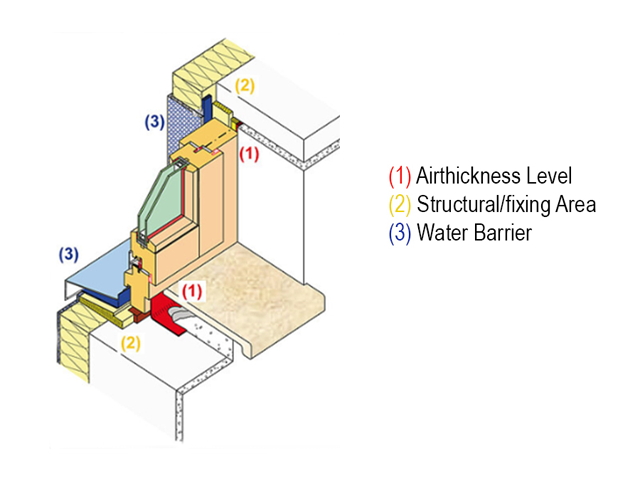
In Europe and especially in Passive Houses, tapes are used to seal cavities around windows. The below image is from the Institute for Window Technic in Rosenheim, which also tests products for Passivhaus certification:
Window sills are used to flash the water away from the structure and the window. While installation requirements in Central Europe are extremely stringent, here in Australia there is probably lots of room for improvement. Especially with buildings becoming more airtight, building up more negative pressure inside, hence requiring better practises.
Water should never be allowed to penetrate from the outer skin of the building envelope to the inside. Professional window installation is your insurance against leaking windows.
Want to talk Windows and Doors: Contact us



At Riva Ceramica, we believe exceptional spaces begin with exceptional materials. With 20 years of industry experience, we've ...

A 1ha section of surface car parking at Salisbury Downs' Hollywood Plaza could make way for a new ...

The first building in a new city carries an unusual responsibility. It has to meet an immediate need ...

In a town where summer temperatures can approach 50 degrees Celsius and the nearest neighbouring town is around ...

MA Financial has acquired a 50 per cent stake in The Glen shopping centre in Melbourne’s south-east from ...