Contemporary Curves Meet Historic Charm at Maison Ruinart
Japanese architect Sou Fujimoto has reimagined the visitor experience at Maison Ruinart in Reims, France, with the addition of the Nicolas Ruinart Pavilion. Part of a three-year renovation of the champagne house’s historic site, the pavilion serves as a cultural space and stands as a striking contrast to the site’s 19th-century architecture.

GALLERY


Constructed from local soissons stone, the pavilion is crowned with an asymmetrical wooden roof that sweeps in a graceful curve—an intentional nod to the roundness of a champagne bubble. The facade, crafted from glass that transitions from translucent at its base to opaque at its apex, evokes the effervescence of bubbling champagne. “The curves of this new construction contrast with the straight lines of the historic buildings,” said Ruinart. “The pavilion blends harmoniously with the centuries-old buildings, creating a vibrant dialogue that highlights the modernity of its asymmetric design.”
Sustainability is at the heart of Fujimoto’s design. The pavilion features a green roof, rainwater harvesting, solar panels, and geothermal energy systems, enabling it to meet 80 per cent of its energy needs. The building is encased in a 7,000-square-metre garden by landscape artist Christophe Gautrand, designed as a sanctuary for local biodiversity. Artworks and sculptures punctuate the gardens, creating a scenographic pathway that immerses visitors in the history and natural beauty of the Champagne region.
Inside, interior designer Gwenaël Nicolas has created a light-filled, open-plan space that seamlessly blends the contemporary with the historic. Stone-tiled floors and wooden furniture ground the design, while a glazed front captures the view of the courtyard like a framed painting. “Through the pavilion’s bay window, facing the main courtyard, you see Maison Ruinart as if in a dream,” Fujimoto noted.
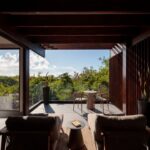
The pavilion houses a reception, bar, and boutique, with sliding doors opening onto a terrace, inviting visitors to linger in the serene landscape. Fujimoto’s Nicolas Ruinart Pavilion exemplifies a thoughtful balance of innovation, sustainability, and heritage, making it a fitting addition to the storied Maison Ruinart estate.
Images by Chloé Le Reste via Dezeen



Wall Rapture joins the Austaron Surfaces collection, bringing authentic mineral character, craftsmanship and design flexibility to contemporary interiors. Known ...
Building in the Galápagos Islands means working within one of the world’s most environmentally sensitive landscapes. For architect ...

A new town centre and a land-lease village of up to 364 homes are proposed for Yalyalup, as ...