Tanatap Frame Garden Café Reimagines the Café as a Walkable Garden
Frame Garden Café, known as Tanatap, represents another prototype in an evolving series of multi-level greenspaces that challenge conventional ideas of façade, program and public space.
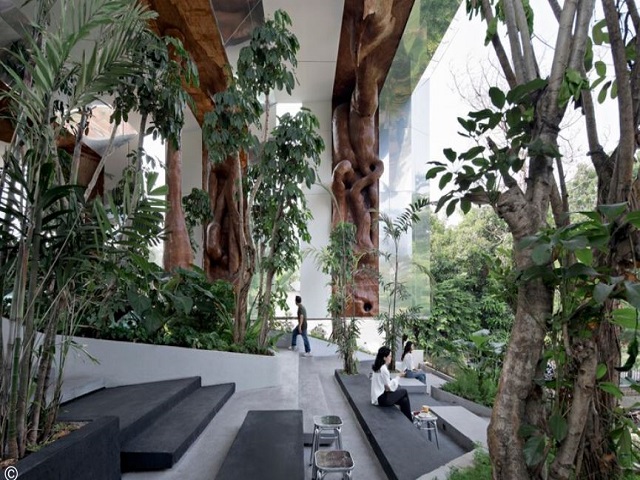
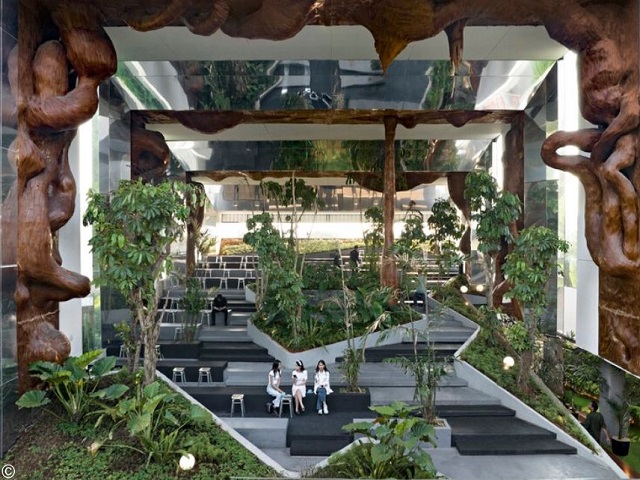
Conceived as a walkable roofscape of rising and falling platforms, the project extends the experience of the adjacent public parks, offering visitors elevated and shifting perspectives across the landscape while positioning architecture as a framework rather than a fixed object.
GALLERY
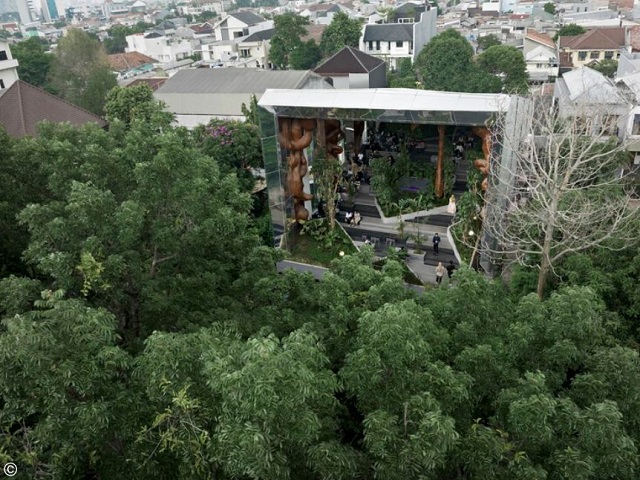
The design begins with a provocation. What if community activity, art exhibitions and gardens themselves could become an ever-changing functional façade? In response, the architect pursued a deliberately façade-less architecture, creating a self-effacing structure where identity is shaped by use rather than form. Sheltered indoor spaces are concealed within a simple layered garden, revealed sequentially as visitors move through the site. Spaces are discovered rather than announced, reinforcing a sense of exploration and curiosity.
Central to the project is a playful juxtaposition of four frame types, stainless steel, artwork, glass fibre reinforced concrete and glass. These frames manipulate perspective so visitors enjoy framed views of the park, while passers-by see café patrons as living exhibits within a civic artwork. The approach reflects an ambition to create a dynamic, sustainable public space that can operate independently in cities like Jakarta, where government-managed parks are often inconsistent in quality and upkeep.
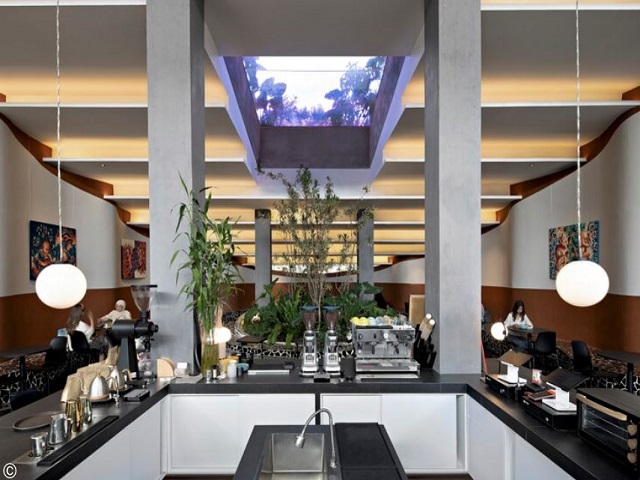
Porosity is celebrated throughout. The building functions as a hovering framed garden, double-shaded to create low-energy interior spaces suited to a high thermal environment. A rainbow-hued skylight punctuates the centre, allowing sunset light to filter deep into the café and producing a series of contrasting ambiences throughout the day. Despite its dense residential context, the project demonstrates how passive commercial design can remain viable and profitable in tropical, developing cities.
Formally, the design explores basic geometry, combining strong cubic volumes on the ground floor with a more organic amphitheatre above. With no defined front or back, the building can be approached from all directions. Frames also act as wind catalysts, drawing breezes through the structure and enhancing comfort.
Internally, spatial compression and release guide movement. Visitors enter beneath a low 2.2-metre ceiling that gradually opens to heights of up to 7.5 metres, blurring indoor and outdoor boundaries along pathways that link two existing gardens. Undefined furniture integrated into the landscape encourages users to reinterpret comfort and occupation, turning the café into an ongoing social experiment. Ultimately, Tanatap operates as a public living room and cultural destination, where art, landscape and architecture continuously reshape the experience of shared space.
Images by Mario Wibowo via ArchDaily


Everyday errands and meals become opportunities to pause, gather and connect at the Luhu residential community, where XU ...
MA Financial has acquired a 50 per cent stake in The Glen shopping centre in Melbourne’s south-east from ...