Solar Underfloor Heating: How to Run It on Rooftop Power
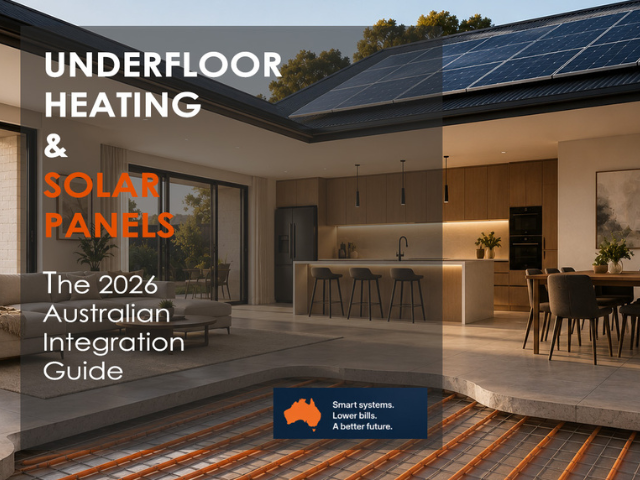
Imagine your rooftop panels working hard at midday and your floors still glowing warm at dinner time. That is the promise of solar underfloor heating, and it works because a heated floor stores energy so well.
GALLERY

The details that make it sing are decided at design stage: system type, insulation, thermostat and solar sizing.
Why solar and underfloor heating pair so well
Rooftop output peaks between roughly 9am and 3pm, often when nobody is home to use it. A concrete slab or well-insulated screed can bank that energy as heat and release it gently through the evening, behaving like a thermal battery.
The better the insulation beneath the slab, the shorter the pre-heat and the longer the evening comfort window.
Solar underfloor heating with electric systems
Electric mats and cables are simple loads. They draw from your panels when power is available and from the grid when it is not, so no special wiring is needed.
Scheduling does the heavy lifting, and a programmable Wi-Fi thermostat such as the MWD5 allows up to four heating events a day.
With north-facing panels, set the main window for roughly 9am to 3pm, with a short morning warm-up and a top-up as the afternoon fades. West-facing panels extend useful generation to about 5pm.
Solar underfloor heating with hydronic systems
For whole-home projects, hydronic heating with an Intaflo air-to-water heat pump is the strongest match.
The heat pump runs entirely on electricity and delivers several units of heat for every unit it consumes, and a typical pattern is one or two cycles in the solar window, such as 10am to 1pm, with a top-up to 3pm.
Comfort Heat Australia’s guidance is a solar system of around 6.6 kW or more for a whole-home installation, with the heat pump sized to the floor area, from 9 kW for 40 to 100 m² up to 30 kW for 250 to 350 m².
Do you need a battery?
Often not, because in a slab system the floor provides the storage at no extra cost. Batteries make more sense for electric room heating or where evening peak tariffs are high.
A sensible path is to install in-slab hydronic, schedule it on solar, review your grid top-up costs after one full winter, then decide. Comfort Heat Australia’s running cost calculator can model your tariff and solar size along the way, so visit the link to find out how much your heating could cost.
What to specify early
A few decisions are best locked in early. Choose a programmable thermostat, since non-programmable units cannot make use of solar scheduling.
Size solar at roughly 3 kW or more for electric room heating and 6.6 kW or more for whole-home hydronic. Insulate under the slab or screed, which is the biggest factor in how long heat lasts, and note the panel orientation, because it sets the generation profile your schedule is built around.
New builds offer the best opportunity, with in-slab hydronic, insulation and solar sized together. For renovations, thin electric mats in bathrooms and kitchens are the simplest solar-ready upgrade.
About Comfort Heat Australia
Comfort Heat Australia is Australian owned and operated, with more than 25 years of experience and 75 years of combined engineering and installation expertise across its team.
We deliver complete electric and hydronic underfloor heating for homes, apartments and larger developments, from custom design and supply through to installation support and ongoing care. If underfloor heating is not the right fit for your project, the team will tell you.
Invisible Luxury, Irresistible Comfort. Read the full solar underfloor heating guide on the Comfort Heat Australia website.
Planning a solar underfloor heating system and have drawings ready? Submit your floorplan for a custom layout and quote, or contact Comfort Heat Australia on 1300 13WARM with questions or any other requirements.
You can also request a quote online.


Bathroom underfloor heating is the most popular way to add underfloor heating in Australia, and for good reason. ...

Few renovation upgrades are loved and enjoyed as much as a warm floor underfoot, and the good news ...
Imagine your rooftop panels working hard at midday and your floors still glowing warm at dinner time. That ...
Ducted reverse-cycle air conditioning has long been the default whole-home system in new Australian builds, yet underfloor heating ...

The honest answer to what underfloor heating costs is that it depends, but the underfloor heating cost per ...