Underfloor Heating vs Ducted Reverse Cycle: Which Suits Your Project?
Ducted reverse-cycle air conditioning has long been the default whole-home system in new Australian builds, yet underfloor heating is fast becoming the alternative that designers and homeowners ask about.
GALLERY
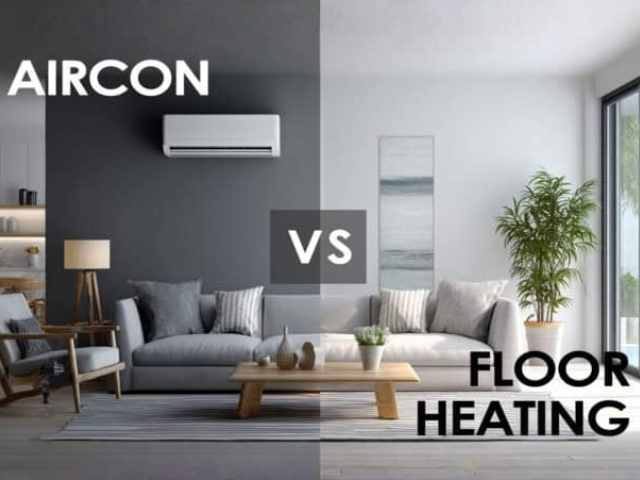
Comparing underfloor heating vs ducted reverse cycle comes down to comfort, air quality, cost, cooling and maintenance, and each system has its moment depending on the project.
Comfort and air quality
Ducted systems heat the air, and warm air rises, so ceilings run warm while floors stay cool. Temperatures swing as the system cycles on and off, and open-plan spaces often heat unevenly.
Underfloor heating works the other way around, warming the floor and radiating comfort evenly, with no draughts, no fan noise and no visible vents.
Because it moves no air, there is also no circulating dust, pollen or pet dander and no drying of the air, which makes a real difference for households with asthma or allergies.
Underfloor heating vs ducted reverse cycle: costs
Heating a medium 160 m² home with ducted reverse cycle costs roughly $1,400 to $1,600 a year, with installation of about $8,000 to $16,000 in a new build. Hydronic underfloor heating powered by an Intaflo heat pump comes in at roughly $1,200 to $1,500 a year for the same home, from about $150 per m² installed plus the heat source. Electric underfloor heating costs about 2 to 5 cents per m² per hour to run and roughly $100 to $200 per m² installed, so a 5 m² bathroom costs under $65 for a full winter.
These are indicative figures, and tariff, insulation and climate will move them, so use the running cost calculator to test your own tariff and floor area.
Cooling is the real trade-off
Underfloor heating heats only, and that is its honest limitation. In warm states, where cooling matters as much as heating, ducted remains the simpler single-system answer.
In cooler regions such as Victoria, Tasmania, the ACT and alpine NSW, underfloor heating as the primary source with a split system for summer is a well-established combination.
Maintenance
Electric underfloor heating has no moving parts, filters or fluids and is rated for 25 to 35 years of service, while hydronic needs an annual heat pump service. Ducted systems need regular filter cleaning, refrigerant servicing and duct inspection.
Both underfloor options also work happily with rooftop solar, with hydronic able to pre-heat the slab during peak generation.
Choosing the right system
Ducted reverse cycle suits warm climates where cooling is needed, or homes with existing ducts.
Electric underfloor heating is ideal for individual rooms, renovations, apartments and townhouses.
Hydronic underfloor heating suits new builds and whole-home renovations, particularly in cooler regions, where a slab and rooftop solar can work together.
It also leaves no vents, grilles or radiators for the interior design to work around, a point architects and designers value.
About Comfort Heat Australia
Comfort Heat Australia is Australian owned and operated, with more than 25 years of experience and 75 years of combined engineering and installation expertise across its team.
We deliver complete electric and hydronic underfloor heating for homes, apartments and larger developments, from custom design and supply through to installation support and ongoing care. If underfloor heating is not the right fit for your project, the team will tell you.
Invisible Luxury, Irresistible Comfort. Read the full underfloor heating vs ducted heating comparison on the Comfort Heat Australia website.
Comparing heating systems for a project and have drawings ready? Submit your floorplan for a custom layout and quote, or contact Comfort Heat Australia on 1300 13WARM with questions or any other requirements. You can also request a quote online.


Ducted reverse-cycle air conditioning has long been the default whole-home system in new Australian builds, yet underfloor heating ...

The honest answer to what underfloor heating costs is that it depends, but the underfloor heating cost per ...
It is a tiny component, but an underfloor heating floor sensor does a big job. This small probe ...
Karndean has refreshed its established LooseLay Longboard commercial vinyl flooring collection with new timber-inspired designs, enhanced surface finishes ...
For decades, Karndean has helped shape interiors around the world and, in Australia, has become a familiar presence ...