Mirrored Portal Marks Expansion of Ian Potter Museum
The Ian Potter Museum of Art at the University of Melbourne has unveiled its new Education and Programs Centre, a significant expansion that extends into the heritage-listed 1930s Physics Annex on the Parkville campus.
Spanning four levels including a basement, the project strengthens the museum’s civic presence while enhancing its capacity for exhibition, teaching and public engagement.
GALLERY
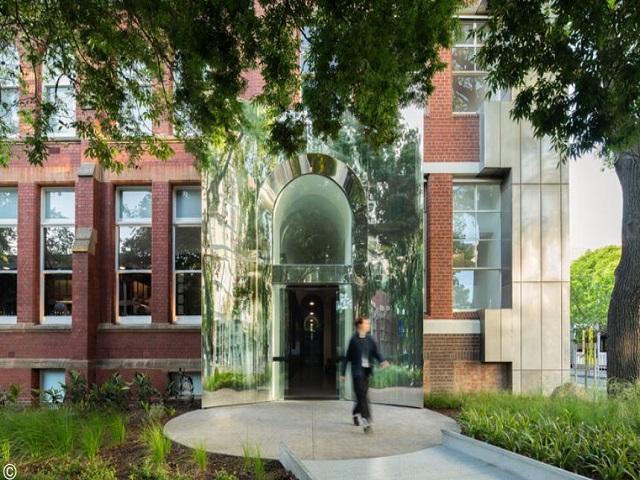
Reorienting the main entry to Masson Road, a key arterial leading out of Melbourne’s city centre, the design establishes a more prominent public interface. A concave, mirrored portal in polished stainless steel projects from the original façade, marking the threshold between campus and city. Reflective and sculptural, the portal captures shifting views of its surroundings, creating a multi-faceted frontage that signals the museum’s renewed identity.
The extension connects seamlessly with the Victorian Architecture Medal-winning gallery completed in 1998, while also integrating the former Bacteriology Building from the early 1900s and the 1930s Physics Annex. Reconciling differing floor levels between the existing museum and annex presented a key challenge, resolved through a carefully considered, DDA-compliant approach that ensures accessibility across the complex.
Close collaboration between the University, the Museum and University Art Museums Australia underpinned a unified vision. Heritage architects Lovell Chen led restoration works, guided by detailed surveys to retain original fabric and architectural integrity. Contemporary systems including thermal upgrades and ‘AA’ environmental controls were sensitively integrated to meet stringent conservation standards.
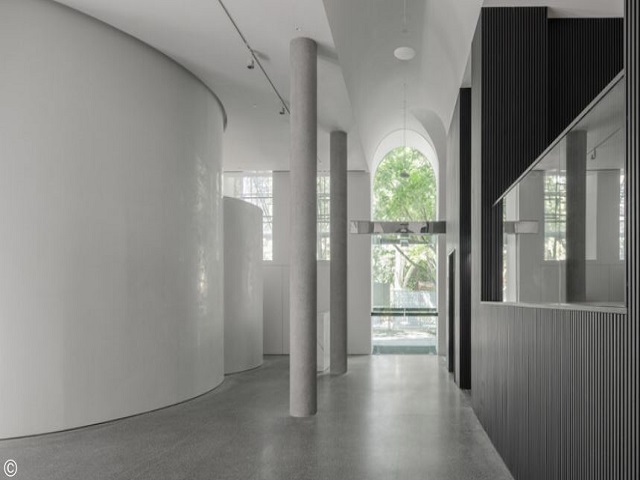
Visitors enter through the portal into a vaulted, double-height foyer, where a monochromatic black timber wall draws sightlines through to Residence at the Potter restaurant and into the existing gallery spaces. Level one accommodates dedicated and hybrid teaching areas supporting the University Art Collection and annual exhibition program. Integrated lighting and climate control systems ensure optimal conditions for both display and preservation.
The new centre also houses seminar rooms, education services, public program areas, cloak rooms, a café and essential back-of-house facilities. Together, the expansion positions the museum as a flexible, future-focused cultural destination for art, social exchange and lifelong learning within the Parkville campus.
Images by Fergus Floyd via ArchDaily


Choosing between hydronic vs electric underfloor heating is one of the biggest decisions in any renovation or new ...
Building in the Galápagos Islands means working within one of the world’s most environmentally sensitive landscapes. For architect ...
A new town centre and a land-lease village of up to 364 homes are proposed for Yalyalup, as ...
Melbourne’s historic Jam Factory is being reimagined as a $4 billion mixed-use precinct, with GURNER aiming to turn ...