Hydronic vs Electric Underfloor Heating: A Buyer's Guide
Choosing between hydronic vs electric underfloor heating is one of the biggest decisions in any renovation or new build.Both options radiate gentle warmth up from the floor to provide invisible luxury and undeniable comfort.
GALLERY
The real difference lies in project type, scale, installation and running cost, and understanding it early helps the whole team specify with confidence.
How each system works
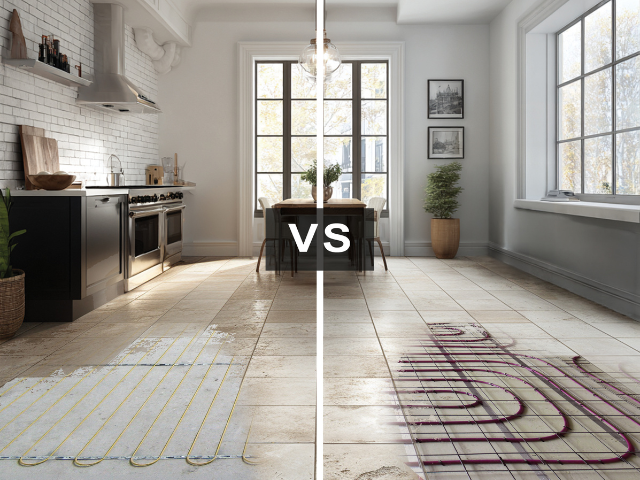
Electric systems use cables or mats beneath the floor finish, including screed cable, thin mats, timber mats, carpet mats and slab cable.
Hydronic systems circulate water, heated to a maximum of about 45°C, through pipe loops that return to a manifold, usually powered by an Intaflo air-to-water heat pump.
Heat-up time
Carpet mats warm in about 20 to 30 minutes, and thin mats and screed cable in around an hour. Slabs can take up to 48 hours to warm but then hold heat like a battery.
That is why electric mats and screed suit on-demand heating scheduled before waking, while hydronic slab and screed suit steady whole-home heating.
Hydronic vs electric underfloor heating: running costs
Electric is usually cheaper for individual rooms because you pay only for the heat you use.
For whole homes, hydronic with a heat pump becomes more economical, particularly with rooftop solar, when the slab can be pre-heated during peak generation, roughly 10am to 3pm, and release its warmth into the evening.
Installation and cost
With electric, thin mats sit in the tile adhesive with minimal height impact, and screed cable suits renovations with a new screed. Costs start from about $380, DIY kits are available, and a licensed electrician must make the connection.
Hydronic is a bigger undertaking. Pipes are laid before the screed or slab is poured, with at least 30 mm of cement cover and a total build-up of at least 50 mm, and a licensed plumber is required. It suits areas of about 80 m² or more, starts from around $8,000 and must be planned from the design stage.
Maintenance and climate
Electric has no moving parts and needs no maintenance, while hydronic needs periodic checks of water quality, inhibitor and pressure, plus an annual heat pump service. Electric suits temperate and coastal climates, where heating windows are short and response is quick. Hydronic suits colder regions such as Melbourne, Canberra, Hobart and alpine areas, where slab thermal mass holds heat through cold nights.
Which should you specify?
Choose electric for bathrooms, laundries, kitchens, apartments and renovations where floor height cannot change.
Choose hydronic for new homes, major renovations with floors opened up, large or high-spec builds and cold-climate homes.
Both can run fully electric, a growing consideration as gas is phased out of new builds.
About Comfort Heat Australia
Comfort Heat Australia is Australian owned and operated, with more than 25 years of experience and 75 years of combined engineering and installation expertise across its team.
We deliver complete electric and hydronic underfloor heating for homes, apartments and larger developments, from custom design and supply through to installation support and ongoing care.
If underfloor heating is not the right fit for your project, the team will tell you. Invisible Luxury, Irresistible Comfort.
Read the full hydronic vs electric underfloor heating buyer’s guide on the Comfort Heat Australia website.
Choosing between electric and hydronic for a project and have drawings ready? Submit your floorplan for a custom layout and quote, or contact Comfort Heat Australia on 1300 13WARM with questions or any other requirements.
You can also request a quote online.


Choosing between hydronic vs electric underfloor heating is one of the biggest decisions in any renovation or new ...
Building in the Galápagos Islands means working within one of the world’s most environmentally sensitive landscapes. For architect ...

A new town centre and a land-lease village of up to 364 homes are proposed for Yalyalup, as ...

Melbourne’s historic Jam Factory is being reimagined as a $4 billion mixed-use precinct, with GURNER aiming to turn ...
Delivering a high-performance building requires more than specifying efficient products. At The Illawarra Grammar School in Wollongong, the ...